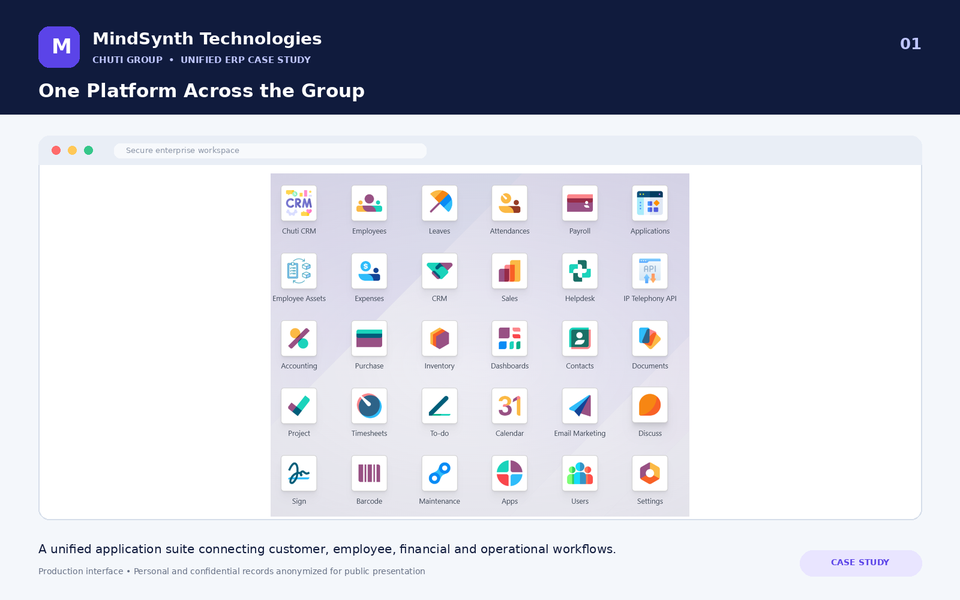
Shark Limited — Integrated Standard Odoo ERP Implementation
MindSynth implemented an integrated standard Odoo environment for Shark Limited, connecting CRM, sales, procurement, inventory, accounting, HR, expenses, projects, helpdesk and field services. Through fit-gap analysis, structured configuration, data migration and extensive role-based training, Shark gained a scalable operational platform without unnecessary custom development.
Supply Chain, Data Center Infrastructure, Engineering Solutions and Field Services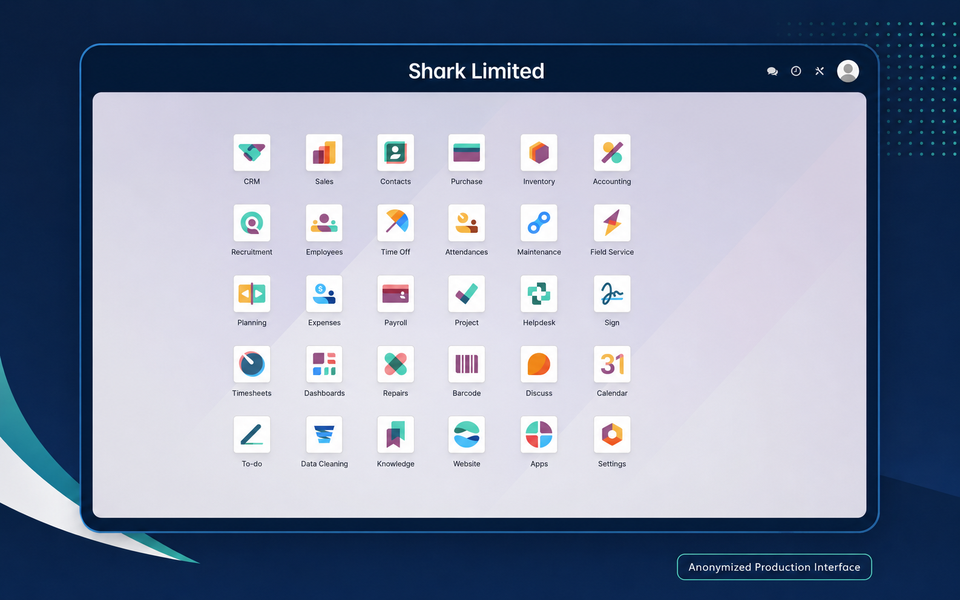
What We Built
CRM and Opportunity Management
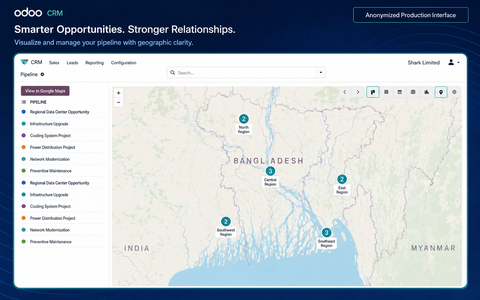
Structured pipelines connect leads, project opportunities, customer activities, quotations, geographic visibility and sales reporting.
Sales and Quotation Management
Standard sales workflows support customer management, quotation preparation, follow-up, order confirmation and sales analysis.
Procurement and Inventory
RFQs, purchase orders, vendors, products, receipts, warehouse movements, stock visibility and replenishment operate within one supply-chain workflow.
Accounting and Expense Control
Invoices, customer and vendor balances, journals, payments, expenses, approvals and financial reporting are managed through an integrated accounting environment.
HR, Attendance and Payroll
Employee records, recruitment, attendance, leave, payroll and related HR activities are managed through connected standard applications.
Project and Resource Management
Projects, tasks, milestones, timesheets, planning, responsibilities and progress reporting support coordinated engineering delivery.
Helpdesk and Customer Support
Structured ticketing, assignment, service workflows and follow-up improve visibility into customer-support activities.
Field Service Management
Field tasks can be scheduled, assigned, completed and connected with customer approval and relevant commercial processes.
Data Migration and User Enablement
Business data was prepared and migrated, followed by 40 hours of module-specific training and practical user guidance.
See It In Action

Project Type:
Standard Odoo ERP Implementation, Configuration, Data Migration and User Enablement
Technology Platform:
Odoo Standard, Integrated Odoo Business Applications, Role-Based Access, Standard Reporting, Dashboards and Map-Based CRM Visualization
Services Provided:
Requirements Elicitation, Business Process Analysis, Standard Odoo Fit-Gap Assessment, Solution Configuration, Master Data Preparation, Data Migration, User Acceptance Testing, Role-Based Training, Documentation and Post-Implementation Support
Engineering Operational Excellence into One ERP
Shark Limited is a Bangladesh-based engineering and data-center infrastructure solutions provider. Founded in 1995, the company expanded into Engineering and IT operations in 2000.
Its service portfolio covers data-center infrastructure, cooling, power, electrical distribution, networking, DCIM, safety and security, emergency maintenance, periodic maintenance and other mission-critical engineering solutions. The company works with products and technologies sourced from established international brands and supports projects through sales, procurement, engineering execution and aftersales service.
This operating model creates an interconnected business lifecycle. A customer opportunity may require technical consultation, quotation preparation, internationally sourced products, procurement planning, inventory coordination, project execution, field-service activities, customer support and financial follow-up.
Shark therefore needed more than an isolated CRM or accounting application. It required one operational environment capable of connecting commercial, supply-chain, engineering, service, people and finance functions.
MindSynth Technologies implemented this environment using standard Odoo applications.
The Business Requirement
Shark’s business combines project-oriented sales with product supply, engineering services and continued technical support.
Its operational requirements included:
· Managing a substantial pipeline of engineering and infrastructure opportunities
· Organizing opportunities by stage, salesperson, team and geographic location
· Maintaining customer and supplier information centrally
· Preparing and following up quotations
· Connecting sales requirements with procurement and stock availability
· Managing internationally sourced products and technical items
· Tracking projects, tasks, milestones and responsibilities
· Scheduling engineering and field-service activities
· Recording employee time and operational expenses
· Managing customer-support requests
· Connecting operational transactions with accounting
· Maintaining employee, attendance, leave and payroll records
· Providing management with reliable operational reports
The objective was to automate and integrate these processes while keeping the implementation maintainable and aligned with Odoo’s standard product architecture.
A Standard-First Implementation Strategy
Shark Limited selected Odoo Standard licensing. Under the agreed implementation model, custom software development was intentionally excluded.
This made the quality of requirements analysis and fit-gap assessment especially important.
Instead of translating every existing working habit into software customization, MindSynth evaluated each requirement against Odoo’s standard capabilities. Business activities were categorized as:
· Directly supported by standard Odoo
· Achievable through configuration
· Achievable through process alignment
· Requiring data preparation or migration
· Requiring user training and operational guidance
· Outside the approved standard implementation boundary
This approach protected the solution from avoidable technical complexity while retaining the upgradeability, consistency and maintainability of the standard platform.
The result demonstrates that ERP transformation does not always require extensive custom development. With the right analysis, configuration and user enablement, standard Odoo can support a broad and interconnected operational environment.
Requirements Elicitation and Fit-Gap Analysis
MindSynth began by discussing Shark’s operational requirements with management and relevant business functions.
The analysis covered:
· Lead and opportunity management
· Sales pipelines and team structures
· Customer and supplier records
· Quotation and order workflows
· Product and stock management
· Procurement and supplier activities
· Accounting configuration
· Employee and HR operations
· Project structures and milestones
· Timesheets and resource planning
· Expense submission and approval
· Helpdesk workflows
· Field-service scheduling
· Reporting and management visibility
· Existing data and migration readiness
· User roles and access requirements
The objective was not merely to activate applications. Each application had to be configured so information could move coherently from one business function to another.
CRM for Project-Oriented Sales
Shark’s CRM is used to manage a wide range of project, supply and service opportunities.
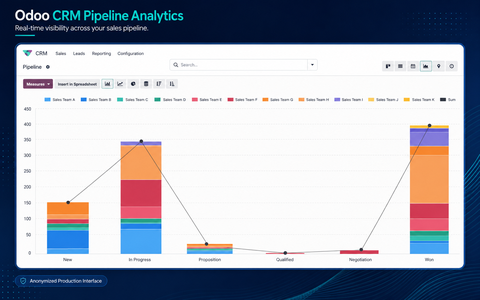
The production environment demonstrates a structured pipeline containing stages such as:
New → In Progress → Proposition → Qualified → Negotiation → Won
Opportunities can be organized and analyzed using standard Odoo views, filters, groupings and reporting tools.
Configured capabilities include:
· Lead and opportunity registration
· Customer and contact association
· Salesperson and sales-team assignment
· Pipeline-stage management
· Scheduled calls, meetings and follow-up activities
· Opportunity prioritization
· Expected closing and next-action tracking
· Quotation preparation
· Opportunity history and communication
· Stage-wise pipeline analysis
· Salesperson and team performance reporting
· Chart, pivot, list, calendar and dashboard views
· Geographic opportunity visualization
The map-based view provides an additional management perspective by displaying the geographic distribution of opportunities. This is particularly valuable for an organization coordinating customers, engineering projects and service requirements across multiple regions.
Management Reporting and Pipeline Visibility
Standard Odoo reporting transformed the CRM pipeline into an interactive management resource.
Authorized users can analyze opportunities by:
· Pipeline stage
· Salesperson
· Sales team
· customer
· activity status
· geographic location
· expected closing period
· outcome
· other standard analytical dimensions
Graphical reports make it easier to identify where opportunities are concentrated, how work is distributed and which stages require attention.
Reports can also be explored through bar, line, pie, pivot and tabular views without exporting operational data into disconnected reporting files.
This provides management with a more consistent view of the sales operation while allowing users to investigate the underlying records when necessary.
Connecting Sales with Procurement and Inventory
Shark supplies specialized engineering and data-center infrastructure products. Sales commitments therefore depend on supplier coordination, product availability and procurement planning.
The configured standard workflow connects:
· Customer requirements
· Quotations and sales orders
· Product records
· Vendor information
· Requests for Quotation
· Purchase orders
· Goods receipts
· Warehouses and stock locations
· Inventory movements
· Customer delivery
· Supplier billing
· Customer invoicing
Procurement and inventory capabilities include:
· Vendor-master management
· Product-master management
· RFQ preparation
· Purchase-order processing
· Supplier comparison and follow-up
· Incoming product receipt
· Opening-stock management
· Internal stock movement
· Current stock visibility
· Inventory reporting
· Barcode-supported operations where applicable
This integration reduces the need to reproduce the same commercial and product information across separate systems.
Accounting and Financial Management
Accounting was configured to connect financial records with operational transactions.
The standard accounting scope includes:
· Chart of accounts
· Accounting journals
· Bank and cash accounts
· Customer invoices
· Vendor bills
· Accounts receivable
· Accounts payable
· Payment terms
· Tax configuration
· Expense tracking
· Customer and supplier balances
· Opening balances
· Trial-balance migration
· Financial reporting
Because accounting is connected with sales, purchases, inventory and expenses, authorized finance users can trace transactions back to their operational sources.
This creates a stronger basis for reconciliation, financial control and management reporting than maintaining independent operational and accounting records.
Employee and HR Operations
The Odoo environment also supports Shark’s people-management requirements.
Standard applications cover:
· Employee records
· Departments and organizational information
· Recruitment activities
· Attendance
· Time off and leave
· Payroll processing
· Employee expenses
· Work schedules
· Timesheets
· Planning
· HR reporting
Bringing these activities into the same ERP creates a clearer connection between employees, assigned work, attendance, time, expenses and payroll-related activities.
Project, Timesheet and Resource Management
Engineering and data-center engagements require coordination beyond the initial sale.
Odoo Project supports the organization of work through:
· Projects and project stages
· Tasks and subtasks
· Assigned responsibilities
· Deadlines
· Milestones
· Dependencies
· Priorities
· Timesheets
· Planned activities
· Progress tracking
· Analytical accounts
· Project reporting
This enables teams to move from commercial opportunity to structured delivery while maintaining clearer responsibility and progress visibility.
Planning and timesheet capabilities help connect people with scheduled work and recorded effort.
Helpdesk, Maintenance and Field Services
Customer relationships in the engineering and infrastructure sector continue after products are supplied or projects are commissioned.
Standard Odoo applications provide a structured environment for:
· Customer-support tickets
· Ticket assignment
· Priority and status management
· Service activities
· Field-task scheduling
· Engineer or technician assignment
· Onsite work tracking
· Timesheet recording
· Customer approval
· Service completion
· Maintenance activities
· Relevant invoicing processes
· Support and service reporting
This helps transform customer requests into traceable operational work instead of relying solely on informal calls or messages.
Structured Data Migration
Moving into an integrated ERP required existing business information to be prepared and transferred into Odoo.
The migration scope included:
· Leads
· Customers and contacts
· Suppliers
· Product master data
· Opening stock
· Employee records
· Salary structures and rules
· Accounting opening balances
· Trial balance
· Other essential operational data
MindSynth provided structured migration templates and guidance for data preparation.
The data was reviewed for the required format before import. This was important because incomplete, duplicated or inconsistently formatted legacy information could otherwise reduce confidence in the new ERP from the beginning.
Data migration was treated as a business-readiness activity, not simply a technical upload.
Phased Implementation
The implementation followed a milestone-based delivery approach.
Phase 1: Core Configuration
Odoo was prepared and the approved standard applications were configured around Shark’s requirements. Initial configuration covered the primary CRM, sales, purchase, inventory, finance and supporting operational applications.
Phase 2: Data Migration
Approved customers, suppliers, leads, products, inventory, employee and accounting data were prepared and migrated using Odoo-compatible templates.
Phase 3: User Training and Adoption
Relevant users received module-specific training covering their operational responsibilities and cross-module dependencies.
The phased approach gave stakeholders opportunities to review the system, understand its workflows and validate the migrated information before relying on it for daily operations.
Forty Hours of Role-Based Training
A major component of the engagement was the planned 40-hour training program delivered across module-specific sessions.
The training allocation included:
|
Training Area |
Duration |
|
CRM and Sales |
7 hours |
|
Procurement and Inventory |
6 hours |
|
Accounting and Finance |
8 hours |
|
HR Management |
7 hours |
|
Expenses and Project Management |
6 hours |
|
Helpdesk and Field Services |
6 hours |
|
Total |
40 hours |
Training focused on practical use rather than generic software demonstrations.
Users learned how to:
· Perform their assigned transactions
· Follow configured workflows
· Maintain accurate records
· Use filters, groupings and reports
· Understand upstream and downstream dependencies
· Recognize when a transaction required another department’s action
· Avoid practices that could damage data quality
· Apply the standard system consistently
This structured enablement helped Shark develop internal capability to operate the ERP without depending on customization for every business scenario.
User Validation and Post-Implementation Support
Configured workflows and migrated data were reviewed with relevant users as part of the transition process.
MindSynth supported:
· Workflow demonstrations
· User validation
· Data review
· Issue identification
· Configuration adjustment within the approved standard scope
· Practical operational guidance
· Go-live assistance
· Post-implementation warranty support
· Minor configuration refinements
The support model remained consistent with the project’s standard-first principle. Enhancements were addressed through configuration and improved usage wherever possible rather than introducing unnecessary custom code.
Operational Impact
The implementation established a connected digital environment across Shark Limited’s major business functions.
The resulting improvements include:
· Sales opportunities are managed through structured, visible pipelines.
· Management can analyze pipeline distribution by stage and salesperson.
· Geographic opportunity visibility supports regional planning and follow-up.
· Customer, supplier, product and employee records are maintained centrally.
· Quotations, purchases, inventory and accounting are operationally connected.
· Procurement teams receive clearer visibility into supplier and product requirements.
· Inventory movements and availability are easier to monitor.
· Projects, tasks, milestones and timesheets can be managed systematically.
· Employee expenses follow a structured submission and approval process.
· Customer-support and field-service activities become traceable.
· Operational transactions can flow into the accounting environment.
· Role-based reporting reduces dependence on separately prepared management files.
· Migrated business data provides a common starting point for system users.
· Extensive training strengthens adoption and internal system ownership.
· The organization benefits from a maintainable solution aligned with standard Odoo.
No unverified percentage-based savings or ROI figures are claimed. The value is demonstrated through stronger integration, process consistency, visibility, traceability and reduced dependence on fragmented information handling.
Why the Standard-First Approach Matters
ERP customization can be valuable when a business has a genuinely unique requirement. It can also introduce avoidable cost, technical debt and upgrade complexity when used unnecessarily.
For Shark Limited, MindSynth demonstrated a different form of ERP expertise: understanding the organization well enough to obtain the required operational value from standard Odoo.
This required:
· Careful process analysis
· Clear scope control
· Realistic fit-gap decisions
· Correct application configuration
· Structured data preparation
· Cross-module understanding
· User-focused training
· Ongoing operational guidance
The implementation preserved the integrity of the standard platform while still supporting a wide range of business activities.
A Connected Platform for a Mission-Critical Industry
Shark Limited helps customers protect and operate mission-critical data-center and engineering infrastructure. Its own internal platform therefore needed to provide clarity across opportunity management, procurement, stock, project delivery, field work, customer support, employees and finance.
MindSynth delivered this foundation through a broad standard Odoo implementation.
The engagement shows that successful ERP implementation is not measured by the volume of custom code. It is measured by how effectively technology, business processes, data and people are brought together.
Through requirements elicitation, fit-gap analysis, disciplined configuration, structured migration, extensive training and post-implementation support, MindSynth helped Shark Limited establish a more connected, visible and scalable operational environment.
Want results like Shark Limited — Integrated Standard Odoo ERP Implementation?
Tell us about your business and we'll get back with a tailored quote.
Other Case Studies